
4 Ways to Finish Your First Quilt (Without the Stress)
You finished your first quilt top and that is awesome!
But the next step in the pattern says ‘quilt and bind as desired’.
You have no idea what you ‘desire’ because you don’t even know what the options are!
Don’t give up
Here’s what I’m afraid is going to happen. You’ve done all this beautiful work, and now your quilt top is sitting in a bag in a closet somewhere. Not because you can’t finish it, but because you don’t know how to finish it. Uncertainty is stopping you from doing anything.
Feeling that way is completely normal. You’re not supposed to automatically know how to finish a quilt. There are actual choices here, and no one has ever explained them to you before.
So let’s fix that.
I’m going to walk you through four ways to finish your quilt top from the least stressful and least time consuming to the most time consuming. You can figure out what’s the best thing for you right now in your life.
Quilting is not supposed to stress you out, so you’ll want to pick a method that works for you with the least amount of stress for you in your life.
Before We Start: Size Matters
My suggestions do vary based on the size of the top. But for this, let’s assume that you have a top to finish that’s throw sized or bigger.
Option 1: Take It to a Longarm Quilter
My number one recommendation for a stress free finish to your top is to take it to a longarmer.
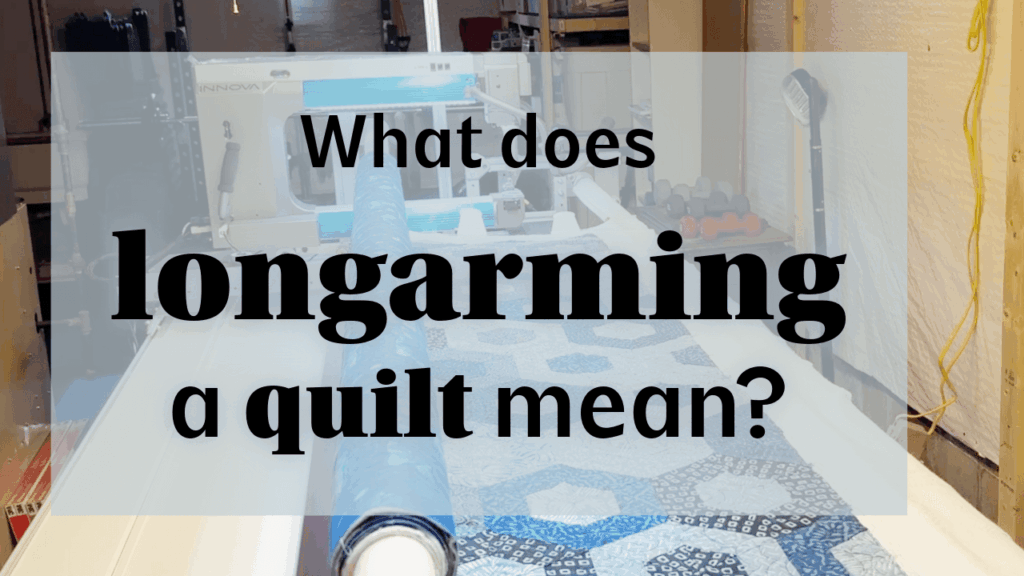
A longarmer is someone who has one of these big specialized machines. And they will quilt your quilt for a fee. The cost goes up depending on the size of your quilt and the complexity of the design that you pick.
“But It Costs Money…”
So yes, it costs money. But you spent money on fabric, right? Plus, you’ve spent oodles and oodles of time piecing that top. Getting it finished is worth it.
But the main reason I’m recommending this particular method is I want you to make another quilt.
Taking it to a longarmer to finish is the least amount of stress, and it will make you the happiest.
If this final step of making your quilt is something where you’re stressed out physically and emotionally, it’s just not going to be a pleasant experience and you’re not going to want to make another quilt. That would really stink, because you’ve proved now that you can make a quilt top. So let’s get it finished so you can prove that you can make a whole quilt.
What Makes This Method Work:
Having someone else quilt your quilt doesn’t take much of your time, and there’s nothing new to learn. It’s not physically demanding.
You’ll get a professionally quilted quilt that you’ll be really happy to use.
You drop it off, they do their thing, you pick it up, you put the binding on. You have a beautiful quilt.
Want to Do It ALL Yourself?
Now, if you really want to do every part yourself, I get that. There’s something really satisfying to say “I made this whole thing.”
Guess what! Many quilt shops allow you to rent time on their longarm. This does require learning something new, how to use the longarm machine, but they will provide training.
Your first time will probably be a little stressful, but if you’re planning to make lots and lots of quilts, this can really save you time and money in the long term.
Wondering what on earth a longarm is – check out this post – What is longarming a quilt?
Option 2: Tie Your Quilt
Option number two isn’t actually even quilting your quilt. It’s tying your quilt.
You lay out your three layers – the backing, the batting, and the top – probably on the floor unless you have a really big table – then you secure them together every few inches with something like embroidery floss, tying it in little knots.
What to Know About Tying:
This is pretty quick compared to some other methods. The biggest challenge is that you’re crawling around on the floor. So if you’ve got a bad back or bad knees, it might be painful.
In addition, tying isn’t really quite as secure as quilting. You’re making one tie every four or so inches. Instead of long continuous quilting lines.
So the layers in tied quilts are a little more likely to shift and bunch, especially with washing.
When Tying Makes Sense:
If your quilt is going to get some heavy use, it’s going to be washed frequently or be dragged around, tying might not be the best choice.
But if your quilt is just going to live on the back of a couch, it’s a very good choice. It’s fast. It’s simple.
Option 3: Machine Quilt on Your Regular Sewing Machine
You can machine quilt your quilt on your regular sewing machine.
Lots of people love doing this. They find it really satisfying that they’re doing the whole quilt by themselves. Once you’ve got a lot of practice and time in, you can get really good at controlling your quilting design and choosing what you want to put on your quilt.
But honestly?
For a beginner quilter working on a throw sized or bigger quilt, it’s just really tough.
My whole goal is to help you make more quilts, not dread the finishing process.
Here’s what machine quilting a big quilt involves.
First, you do have to layer and baste everything together. And again that involves crawling around on the floor on your hands and knees again.
Then you have to maneuver your quilt through your machine. When you’re quilting in the middle of the quilt, you’re going to have to put half the quilt up under the arm of your machine and keep it shoved in there, while still trying to carefully move your quilt through the machine so that you get nice stitches.
At the same time, the two other sides of the quilt are either up over your shoulder or way out in front of the machine hanging off a table.
It’s just really physically demanding. And this can be really overwhelming, especially the first time you do it.
When Machine Quilting Makes Sense:
Now, if you have a baby sized quilt or a table runner, this is an excellent choice. You can absolutely machine quilt smaller quilts on your regular machine without a lot of stress. It’s the smaller size that makes it more manageable.
If you want to learn machine quilting because it interests you, go for it. I’m not saying don’t do it. I’m just saying be aware of what you’re getting into before you start.
If you want to try it, I do have a complete post on finishing – including binding – that shows you how to layer baste and machine quilt a smaller quilt – How to finish your quilt
But again, for your first big quilt, I don’t recommend it. I’m worried that you’re going to get stressed out and never want to make another quilt.
Option 4: Hand Quilt
The last option is to hand quilt.
This is really only last because of the time it takes.
You do still have to baste the quilt, which means you’re probably crawling around on the floor. But once it’s basted, you can sit comfortably with the quilt in your lap or in a hoop and hand stitch it.
What to Know About Hand Quilting:
Handquilting does have a little bit of a learning curve. You have to do this special rocking stitch., and you’ll build up some calluses, but it can be very, very relaxing.
If you’re drawn to this, you’re probably someone who likes to do handwork and you will have a wonderful time doing this.
Just be aware that it is going to take quite a while as compared to some of the other methods.
Think About What You’re Doing
Think about what you’re doing when you’re choosing how you’re going to finish your quilt.
You’re not looking for the right method to do it. You’re looking for the method that’s going to work well for you right now in your life.
And that’s not because you’re a beginner who doesn’t know better. It’s because you’re being smart and protecting your love of quilting.
The quilters who make quilts after quilts after quilt are not the ones who figured out how to do it some certain right way. They’re the ones who figured out how to do it their right way. The way that makes them happy to be quilting.
Which Method Is Right for You?
What’s your situation?
Do you have the budget for a longarmer and want a stress free option? That’s smart, not lazy.
Do you have a decorative quilt that won’t be washed constantly and those ties on the front will look really nice and interesting? Then tie it.
You have a smaller quilt and you’re ready to try machine quilting? Go for it!
Or are you drawn to doing hand sewing and hand quilting? Does it sound fun and you know you’d love to sit on the couch and take that time? Then hand quilt!
This is about making quilting work for your life. And that’s not because you’re a beginner. It’s because you want to do this for a long time. So you want to enjoy the process.
Once you finish this quilt, you’ll know whether that method worked well for you, and you’ll have that knowledge for finishing your next quilt
There will be a next one. That’s the whole point of finishing this one in a way that makes you happy.
Whatever you choose, you’re choosing to finish something beautiful that you made.
Knowing that you can finish a quilt means that you can leap right into the next one with confidence.


